AI Foundry is in beta. We are actively shaping the product, so things may change as we iterate. Your feedback is welcome.
Prompt
A Prompt is a catalog resource that stores a reusable piece of text (typically a user message, an instruction template, or a few-shot example set) that agents and Playbooks can reference by name.
Centralizing prompt text in the catalog keeps it version-controlled, searchable, and decoupled from the agents that consume it. When a prompt needs to change you update it in one place and every referencing resource benefits automatically.
Why centralize prompts?
Prompt engineering is an iterative process. Raw prompt strings scattered inside agent definitions or hard-coded in application code are difficult to audit, compare, or collaborate on. Treating prompts as first-class catalog resources gives you:
- Reuse. Multiple agents or playbook nodes can reference the same prompt without duplicating text.
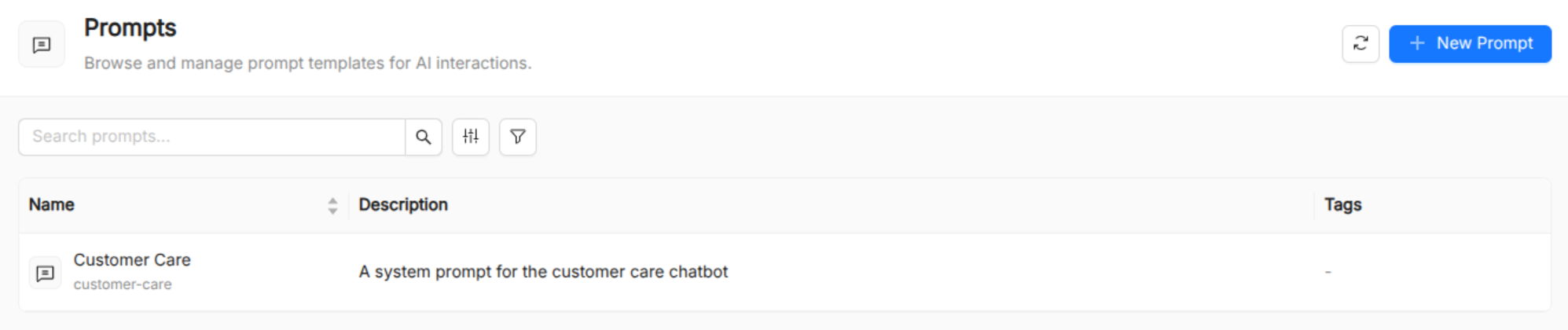
- Discoverability. Prompts are listed and searchable in the AI Foundry UI, with full-text and tag-based filtering.
- Separation of concerns. Prompt authors (often domain experts or technical writers) can work independently from the engineers who wire agents together.
- Auditability. Every prompt update is tracked as a new resource version by the Catalog.
Prompt reference
| Field | Required | Description |
|---|---|---|
Title | Yes | Display name shown in the UI. |
Name | Yes | Unique identifier. Used when referencing the prompt from playbooks. |
Description | Yes | Short description of the prompt's purpose. |
Prompt | Yes | The full prompt text. Supports Markdown. Rendered with syntax highlighting and a preview pane in the UI. |
Prompt content guidelines
Be explicit about role and constraints. Clearly state what the LLM should and should not do. Vague prompts produce inconsistent outputs.
Use Markdown for structure. Headings, bullet lists, and code blocks inside the prompt text help the LLM distinguish sections of a long instruction.
Document placeholders. If the prompt uses template variables (e.g. {{ticket_content}}), document them in metadata.description so consumers know what context they must provide.
Keep prompts composable. Prefer short, focused prompts that address one concern. A playbook can inject multiple prompts into different nodes rather than bundling everything into one.