Beta
AI Foundry is in beta. We are actively shaping the product, so things may change as we iterate. Your feedback is welcome.
Model
A Model is a catalog resource that wraps the configuration needed to connect to a large language model (LLM) provider. It decouples the LLM choice from the agents that use it: agents reference a model by name, so swapping the underlying model (or updating API credentials) requires changing only the Model resource without touching any Agent.
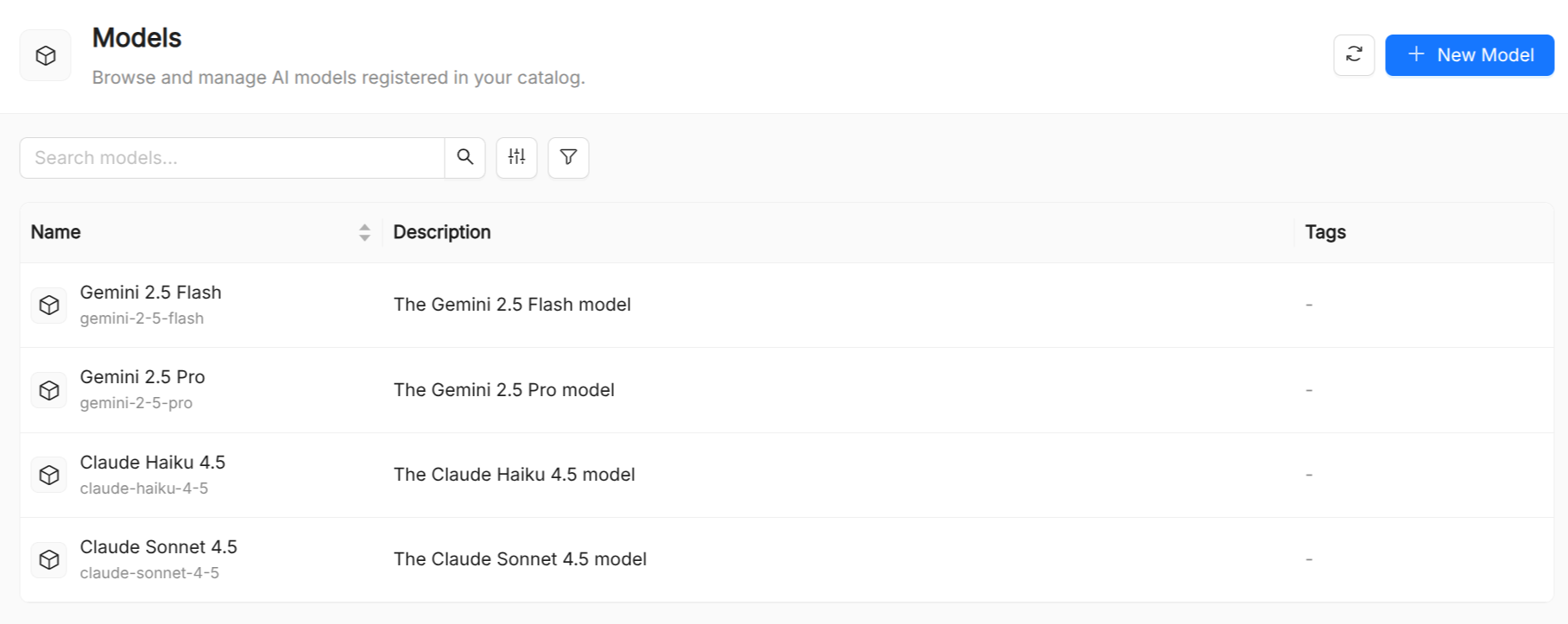 .
.
Model reference
| Field | Required | Description |
|---|---|---|
Title | Yes | Display name shown in the UI and in the agent creation form's model picker. |
Name | Yes | Unique identifier. Must match the value used in Agent.spec.model. |
Description | Yes | Short description of the model's capabilities or intended use. |
Type | Yes | Provider identifier string. Common values: openai, anthropic, azure, ollama/<model>, mistral. Passed to the LLM client unchanged. |
Provider | Yes | Provider name displayed in the UI model picker (e.g. openai, anthropic, ollama). |
Secret | No | Name of the environment variable that holds the API key. The key is never stored in the catalog; only its variable name is. |
URL | No | Base URL of the LLM API endpoint. Defaults to the provider's public endpoint when omitted. Must be a valid URL. |
Context Window | No | Maximum context window size in tokens. Informational; surfaced in the model detail view. |
Supports Tools | No | Set to true if the model supports tool/function calling. Used by the AI Playground to determine which agent features are available. Defaults to false. |
Supports Vision | No | Set to true if the model accepts image inputs. Defaults to false. |
LiteLLM | No | When true, requests are routed through a LiteLLM proxy, enabling a unified interface for any provider LiteLLM supports. Defaults to false. |
Arguments | No | A free-form JSON object with default parameters applied to every request (e.g. temperature, max_tokens, top_p). Individual agents can override these via Agent.spec.model_arguments. |
See also
- Agent: resources that reference a model.